

Microsoft runs its own interviews on Teams. So do most banks, consultancies and any company whose IT department lives in Microsoft 365. The call is on Teams, the code is on a Codility or HackerRank link, and at some point the interviewer says the sentence every candidate with an AI tool is waiting for: "Can you share your screen?"
That sentence is the whole question. Microsoft Teams has no feature that scans your computer for interview apps, and Microsoft has published no statement about detecting them. What Teams does have is a screen share that shows exactly what you choose to share, a recording that keeps it, and a new bot detector that candidates keep misreading as something aimed at them.
This guide goes through what Teams can and cannot see, the three ways candidates actually get caught on a Teams call, and how InterviewMan stays out of a Teams share on Windows and Mac, down to the operating system calls.
We build InterviewMan, so read the comparison with that in mind. Every claim about another tool links to its source. The story of two candidates' Microsoft rounds, including the interviewer who objected to Teams in the browser, is in our separate guide on how to use AI during a Microsoft Teams interview.
Last updated: November 15, 2026.
Key takeaways:
- Teams does not detect AI tools. It shows the interviewer what you share, records it if recording is on, and nothing else about your computer. Microsoft documents no feature that lists a participant's running apps.
- The 2026 Teams "AI bot detection" is about bots that join the meeting as participants. An app running on your laptop is not a participant, so it is not what that feature looks at.
- The real risk is an entire-screen share. Parakeet AI has a public user report of showing up in exactly that case, and any tool that is not excluded from capture at the operating-system level ends up in the recording.
- InterviewMan's window is excluded from Windows and macOS capture, never takes focus from Teams, and keeps its shortcuts away from the browser. In Stealth Mode nothing runs on the shared screen at all.
- It is $12/mo on the yearly plan with a 20-minute free trial and no card. Cluely charges $149.99/mo for the plan that includes hiding from a screen share.
What Teams can see, and what it cannot
Start with what Microsoft actually documents, because most of the fear around Teams comes from features that do not exist.
- The share scope. When you present, Teams asks what to share: your entire screen, one window, or, if you joined from a browser, one tab. The other side sees that and only that. A window share never shows other windows. An entire-screen share shows everything on that monitor, including notifications and anything floating over the browser.
- The recording. Microsoft's own training material says a Teams recording captures audio, video, reactions and screen sharing activity. The support article says the same. If recording is on, whatever appeared in your share can be replayed by the hiring team later, so "the interviewer did not notice" is not the end of the story.
- Copilot. Microsoft has said Copilot in Teams can analyse content shared on screen when recording is on. Again, that is the shared content, not your desktop.
- Bot detection. In 2026 Microsoft added a feature that spots external AI meeting assistants, the note-taking bots, when they join a meeting, labels them, and lets the organiser allow or deny them (Microsoft 365 message MC1251206). It looks at participants. An app that listens through your own microphone is not a participant and never appears in the roster.
- Your other apps. Teams documents no feature that tells an interviewer which applications are running on your computer, which tabs you have open, or what you press on your keyboard. No proctoring is built into a Teams meeting. If a company wants that, it sends you to an assessment platform with its own monitoring, like Codility or HackerRank, and that is a separate question with its own guide: does Codility track tab switching?
So the honest answer to "does Teams detect AI tools" is no. The honest follow-up is that Teams does not have to. If your tool is on the shared screen, the interviewer detects it with their eyes, and the recording keeps it.
Invisible on Teams
Excluded from the Teams screen share and recording on Windows and Mac, silent to the browser, and in Stealth Mode the answers go to your phone. $12/mo on the yearly plan, 20-minute free trial, no card.
Download InterviewManThe three ways candidates get caught on Teams
Every story of someone caught on a Teams call comes down to one of these.
- The overlay is in the entire-screen share. This is the big one. A browser extension, a second browser window, or a desktop overlay that is not excluded from capture appears the moment you share the whole screen. It does not matter that it is "transparent" or "small". Parakeet AI's own feedback board carries a user report titled Parakeet AI got detected in MS Teams entire screen share, on macOS. The vendor's advice to share a window instead is advice to depend on the interviewer never asking for the full screen.
- A phone on camera. Teams interviews are camera-on. A phone propped on the keyboard, a second monitor you keep glancing at, or a tablet in your lap all show up as eye movement and, if the phone is in frame, as a phone. No software fixes this; placement does.
- Shortcuts and focus. When you press a hotkey, something has to receive it. If the overlay's shortcut arrives in the browser as a normal key press, the Codility or HackerRank page in the next tab can log it. And if clicking the overlay takes focus, the test page loses focus, which assessment platforms record as leaving the test. Teams itself does not log either, but the assessment link that usually comes with a Teams interview does. You can check any tool in thirty seconds: open the W3C Keyboard Event Viewer, click in the page, press the tool's shortcuts, and see whether rows appear.
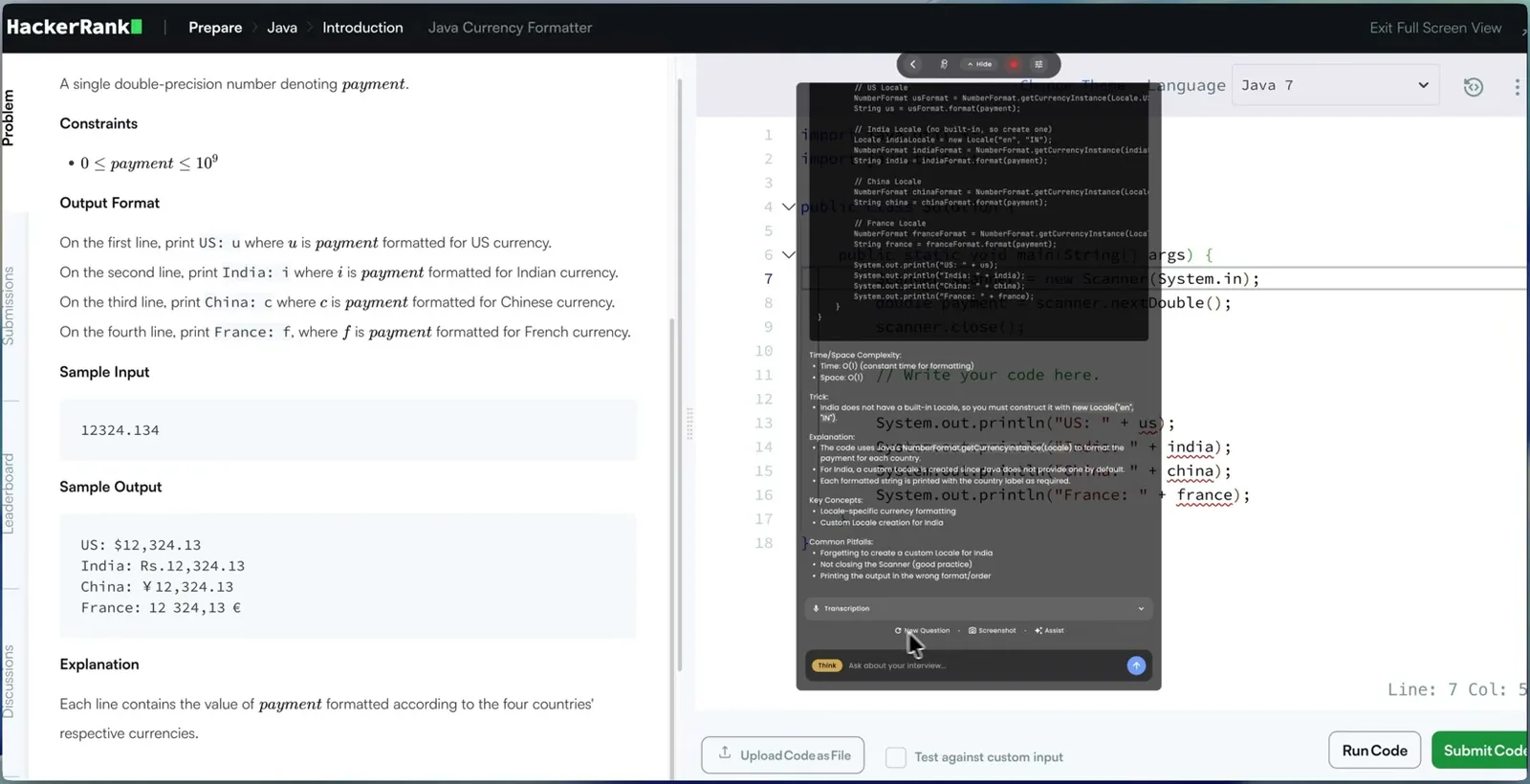
The InterviewMan overlay over a HackerRank task on the same laptop: code, complexity, explanation and common pitfalls, with Run Code and Submit still reachable underneath.
How InterviewMan stays out of a Teams share on Windows
Most Teams interviews happen on Windows, so this is where the engineering matters most. Windows offers an application two ways to say "leave my window out of any capture", and InterviewMan uses both, plus a third layer on top.
- SetWindowDisplayAffinity with WDA_EXCLUDEFROMCAPTURE. This is the Windows flag that tells the compositor to exclude a window from screen capture and recording. It is honoured by Windows Graphics Capture, which is the capture path the Teams desktop app, the Teams web app in Edge or Chrome, and every Chromium-based browser use. Where the overlay would be, the viewer gets the content underneath it.
- SetWindowCompositionAttribute with WCA_EXCLUDED_FROM_DDA. This covers Desktop Duplication, the older capture path some recorders and some older Windows builds still use. On a build where the first flag is refused, this one still holds for every Desktop Duplication capturer.
- Chromium content protection. InterviewMan's Windows app also enables Chromium's own content protection. In July 2026 we verified the result on Windows 11 build 21H2 and build 24H2. The hardest case was the Zoom desktop client on 21H2, which captures through a path the second flag does not cover; the third layer closed that gap in July 2026. Teams, which uses Windows Graphics Capture, was never the hard case.
Three more details decide a Teams interview, and none of them is about the share:
- The window never takes focus. InterviewMan's window is non-focusable. You can click it, scroll it and use its buttons, and Teams or the Codility tab underneath keeps keyboard focus the whole time. The test page never sees a blur event.
- Shortcuts never reach the browser. Every shortcut is registered with Windows as a global hotkey through RegisterHotKey, so the operating system delivers it to InterviewMan and the browser never receives the key press. Ctrl+B hides or shows the window, Ctrl+H takes a screenshot, Ctrl+Enter generates, Ctrl+I turns on mouse pass-through, Ctrl+L starts or stops the microphone, Ctrl+G resets the context, and Ctrl plus the arrow keys moves the window. On the W3C Keyboard Event Viewer the table stays empty while you use them.
- The taskbar and Task Manager. The window is hidden from the taskbar. During install you can give the app a custom name, so Task Manager, the Start menu and the installed-apps list show that name instead of InterviewMan. The process is renamed, not hidden, which is the honest way to say it. Details are in change the app name on Windows.
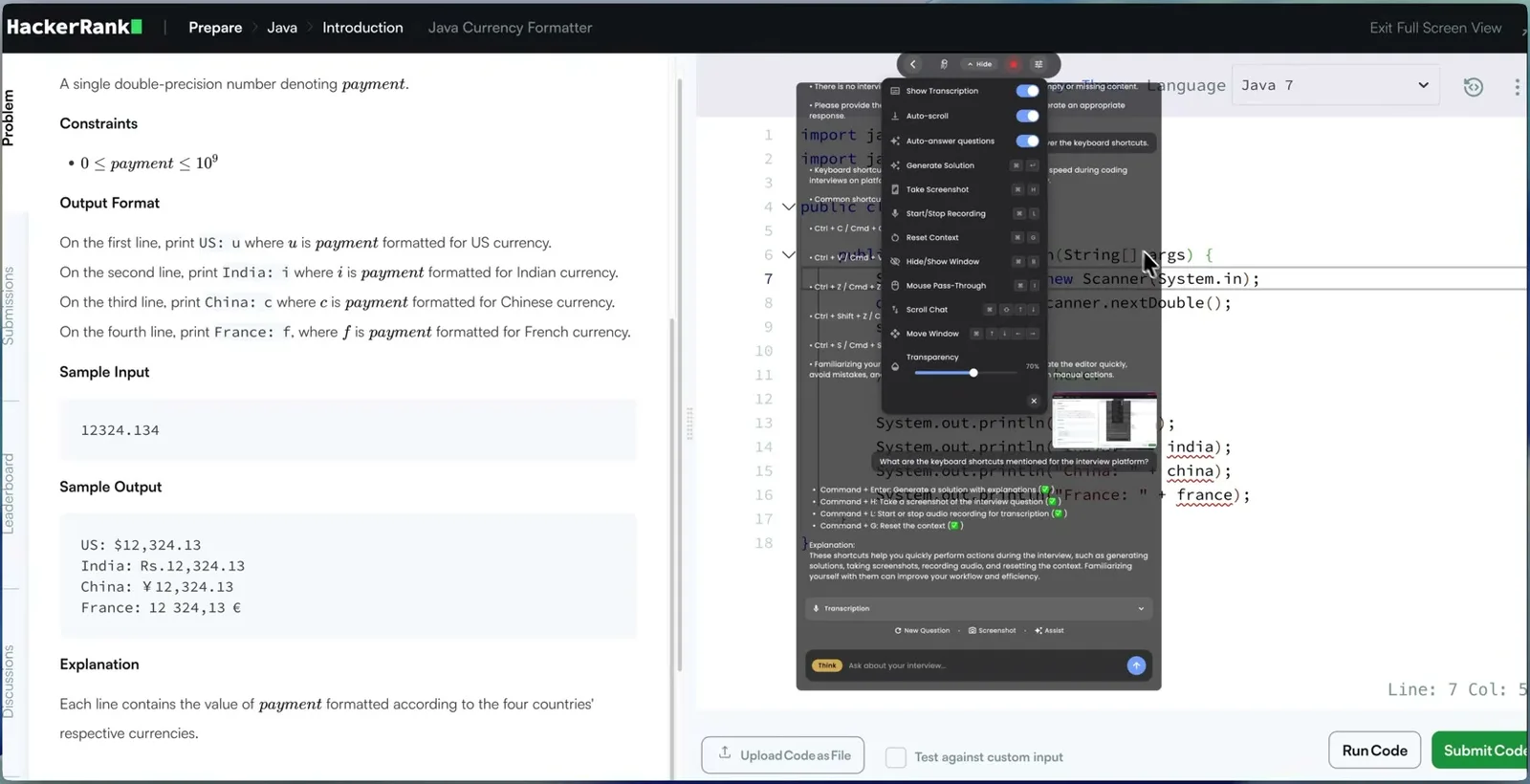
The in-app settings panel: every shortcut in one place, mouse pass-through, and a transparency slider so the overlay can sit over the editor without covering it.
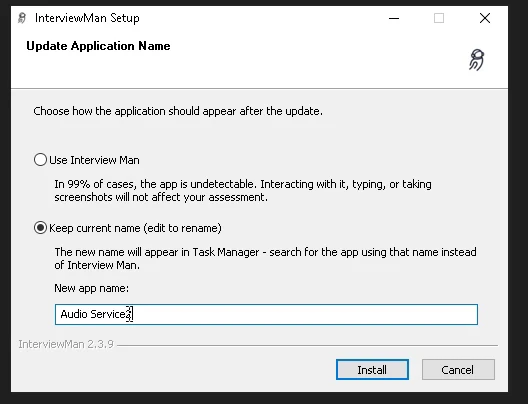
The Windows installer lets you choose the name that Task Manager and the Start menu show. The process is renamed, not hidden.
And on a Mac
On macOS the mechanism is one property instead of three. InterviewMan sets its window's sharing type to "none", the AppKit setting Apple provides so that an app can keep a window out of screen capture. On macOS 13 or newer, the Teams desktop app, Chrome and Edge all capture through ScreenCaptureKit, Apple's current capture framework, and it honours the setting.
The window is also a non-activating panel, so clicking it never activates the app, and the app runs in the background with no Dock icon and no entry in Cmd+Tab. The Mac shortcuts are the same with Cmd instead of Ctrl, registered as system hotkeys.
One honest limit. On macOS 12 Monterey, Chrome still uses an older full-display capture path that ignores the sharing setting, so a browser entire-screen share on macOS 12 can include the overlay. That is an operating-system boundary, not a setting any tool can flip. On macOS 12, use Stealth Mode or share a window. On macOS 13 and later, the setting holds.
Comparison: hidden in a Teams entire-screen share
The whole category claims "undetectable". These are the facts you can check, side by side.
| Tool | Hidden in an entire-screen share | Public detection report | Hiding included or paid extra | Phone mode | Price | Refunds |
|---|---|---|---|---|---|---|
| InterviewMan | Yes: Windows capture exclusion on three layers, macOS sharing type "none" on macOS 13+, plus Stealth Mode where nothing runs on the shared screen | None; zero confirmed detections across its users | Included on every plan | Yes, iPhone and Android, with the laptop hidden | $12/mo yearly ($144/yr) or $30/mo, 20-minute free trial, no card | Yes |
| Parakeet AI | Vendor says window or tab share only | Yes: a user report of detection in a Teams entire-screen share on macOS | Included | No | See vendor | See vendor |
| Interview Coder | Claimed; the vendor's support page admits it can show in Google Meet on Windows 10 | Mixed anonymous Reddit reports | Included | No | $299/mo or $799 once | "No-refund policy for all purchases" |
| Cluely | Only on the paid Undetectability tier | Terms say detection by screen-sharing software is not refundable | Paid add-on: $149.99/mo monthly, $79.99/mo yearly | No | From $149.99/mo with hiding | Not for detection |
| Final Round AI | Claimed, on by default | None found | Included | Phone screens "via another device" | $25/mo yearly or $150/mo, no free live sessions | Check the vendor's terms |
Prices and vendor claims checked November 6, 2026 on each vendor's site; check before paying.
Two things stand out. Only InterviewMan offers a second mechanism for the case where the first one is not enough, and only Cluely charges extra for the one feature this whole page is about.
Stealth Mode: nothing on the shared screen
Standard Mode handles a Teams call. When the Teams call turns into a Codility or HackerRank link with proctoring on, we recommend Stealth Mode, because it removes the tool from the shared computer entirely.
You pair the desktop app with the phone app (or the web app on another device) once; the first pairing takes a few minutes, so do it the day before. On interview day, click Start and choose Stealth Mode. The laptop app hides itself completely, and its window is removed from the operating system's window list, which is the list any monitoring software reads.
From the phone you tap Screenshot, the laptop captures the task and sends it, and the answer appears on the phone. Screenshots wait in a tray until you press Assist, so a long task can be captured in two or three parts. When the round is over, Ctrl+B (Cmd+B on a Mac) brings the window back. The steps are in the Stealth Mode help article, and Normal Mode vs Stealth Mode says which one fits which interview.
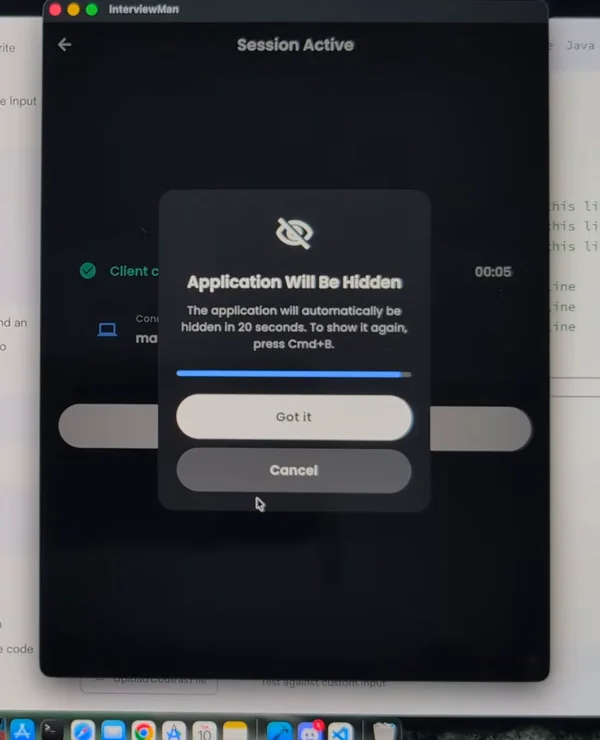
Once the phone connects, the desktop app counts down and hides itself. Cmd+B or Ctrl+B brings it back after the round.
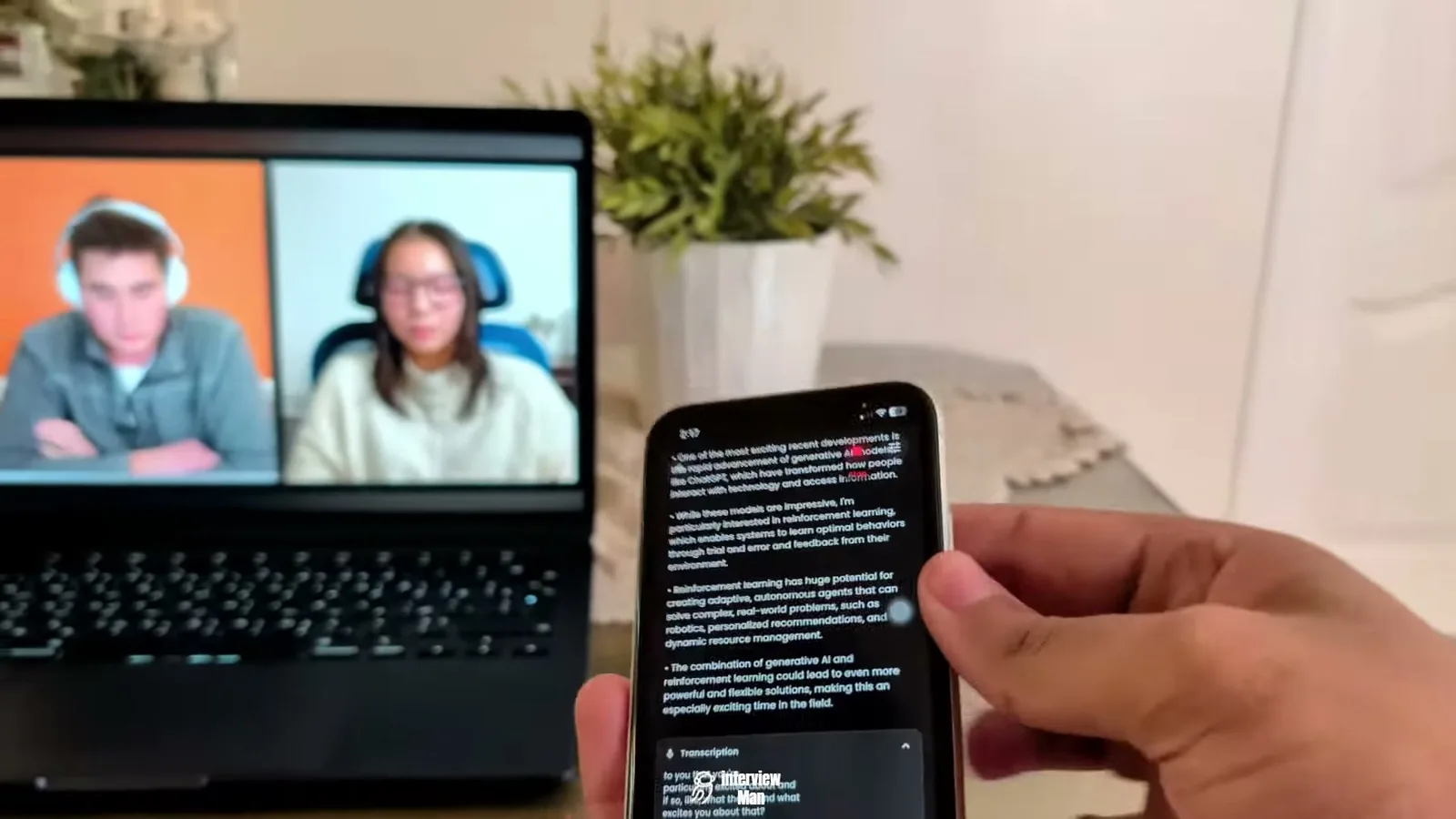
The phone setup on a video call: the call on the laptop, the answer on the phone, nothing on the shared screen.
Invisible on Teams
Excluded from the Teams screen share and recording on Windows and Mac, silent to the browser, and in Stealth Mode the answers go to your phone. $12/mo on the yearly plan, 20-minute free trial, no card.
Download InterviewManStep by step: a Teams interview with InterviewMan
- Install the Teams desktop app and test it the day before. Some interviewers object to Teams in the browser, and a fifteen-minute argument about it is fifteen minutes you do not get back. Both the desktop app and the browser share through the same operating-system capture path, so InterviewMan behaves the same in either.
- Open InterviewMan first, then join. Start a session in Standard Mode before the call connects, so the transcription is already running when the interviewer starts talking. Questions are detected from the audio automatically; press Ctrl+Enter if you want an answer sooner.
- Headphones: turn on Device Audio on the laptop. The Windows app has it on by default; the Mac app on macOS 13 or newer and the web app in Chrome or Edge let you turn it on. Then you can wear headphones and InterviewMan still hears the interviewer. Details in headphones and Device Audio. If you run the app on your phone instead, take the call on the laptop on speaker and keep the phone's headphones off, as explained in hear the interviewer.
- Park the window and turn on pass-through. Move the overlay over the area you will be looking at anyway with Ctrl plus the arrow keys, drop the transparency, and press Ctrl+I so a stray click goes through the overlay to Teams or the editor. Your eyes stay where the camera expects them.
- Share whatever they ask for. Entire screen, window, or tab. The overlay is excluded from capture, so you do not need to steer the interviewer toward a window share, and you do not need to press Ctrl+B in a panic. Hide it anyway when you are not reading it; fewer things on screen means fewer glances.
- When a Codility or HackerRank link appears, consider Stealth Mode. Set it up the day before. For a short unproctored screen, Standard Mode is enough. For a proctored test with a webcam and a full-screen requirement, move the answers to the phone.
- Type the solution yourself, in your own order. InterviewMan explains the approach and comments the code so you understand what you are typing. Never paste. Assessment platforms log pastes and typing patterns, and no overlay changes how you typed.
What people report
The reviews page collects every rating and the Discord reports we were allowed to quote. The one closest to a Teams interview is a screen-shared HackerRank round on Windows, which is the same capture path Teams uses:
- "Had a hackerrank screen sharing interview yesterday with Thomson Reuters. Passed with flying colors. InterviewMan installed on Windows OS, no pass-through enabled, simple standard mode with screenshots. thanks to InterviewMan I am moving to System design round." (a Discord user, August 25, 2026)
- "I just cleared multiple interview rounds this week and the tool has been amazing. The custom instructions is really doing the trick for me." (a Discord user, July 24, 2026)
- Asked whether Stealth Mode had been needed for two rounds of almost two hours each: "no Sir, didn't need it. Ran it on standard mode for 4 hours straight." (a Discord user, July 2026)
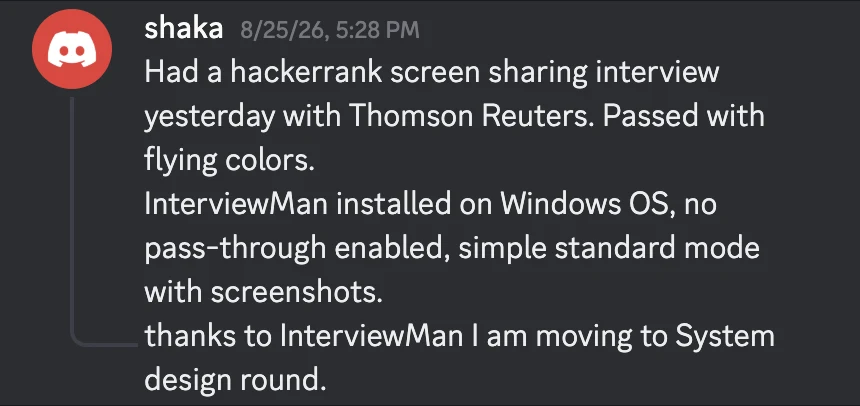
A screen-shared HackerRank interview on Windows in Standard Mode, as posted in the InterviewMan Discord.
InterviewMan is rated 4.9 out of 5 on both the App Store and Google Play, and has zero confirmed detections across its users. That is a track record, not a guarantee. The next section is the part that stays on you.
What no tool can fix
- A phone in frame. Stealth Mode moves the answers off the shared screen. It does not make a phone invisible to a webcam. Put the phone or tablet just below the camera, where your eyes already go, or use a second laptop behind the first. Never pick the phone up.
- Reading instead of talking. Interviewers notice eyes tracking lines of text and answers that arrive in complete paragraphs. Use bullet points and a short answer length, pause, and say each point in your own words.
- Pasted code on the assessment link. Teams does not log pastes. Codility and HackerRank do. Type it.
- An interviewer who asks you to point your camera at the desk. A second device on the desk is then in the recording. Decide beforehand where it sits.
- macOS 12 with a browser entire-screen share. Covered above: Stealth Mode or a window share on Monterey.
Teams is a video call with a screen share and a recording. A tool that is excluded from that capture, silent to the browser and, when it matters, off the shared machine covers the technical side. The camera side is still you.
Frequently asked questions
Can the interviewer see my other apps on Microsoft Teams?
No. Teams shows the interviewer only what you choose to share: the entire screen, one window, or one tab. Microsoft documents no feature that lists a participant's running applications, open tabs or key presses. An app that is excluded from screen capture, like InterviewMan, is not in the shared stream even when you share the entire screen.
Does a Teams recording include my shared screen?
Yes. Microsoft's own documentation says a Teams recording captures audio, video, reactions and screen sharing activity. Anything that appeared in your share can be replayed later by the hiring team, which is why an overlay that is merely "small" is still a risk. InterviewMan's window is left out of the capture, so it is not in the recording either.
Does Teams flag AI assistants?
Teams flags AI bots that join the meeting as participants. In 2026 Microsoft added detection and labelling of external meeting-assistant bots, and the organiser can allow or deny them. An app that listens through your own microphone never joins the meeting and never appears in the participant list, so that feature does not apply to it. InterviewMan never joins a call as a participant.
Is InterviewMan visible in a Teams entire-screen share?
No, on Windows and on macOS 13 or newer. On Windows the window is excluded through SetWindowDisplayAffinity, the Desktop Duplication exclusion attribute and Chromium content protection, verified on Windows 11 21H2 and 24H2. On macOS the window's sharing type is "none", which ScreenCaptureKit honours. The one exception is macOS 12 Monterey with a browser entire-screen share, where Chrome's older capture path ignores the setting; use Stealth Mode or share a window there.
Does Teams in the browser change anything?
Not for detection. Teams in Edge or Chrome and the Teams desktop app both capture through the same operating-system path, so a window that is excluded from capture is excluded in both. The browser version adds a tab-share option and can trigger a complaint from an interviewer who expects the desktop app, so install the desktop app the day before.
Does Teams see my keyboard shortcuts?
No, and neither does the assessment page in the next tab, as long as the shortcut never reaches the browser. InterviewMan registers its shortcuts with the operating system as global hotkeys, so the system delivers the key press to InterviewMan and the browser never receives it. You can check any tool on the W3C Keyboard Event Viewer: press its shortcuts and see whether rows appear.
Download: InterviewMan for Mac, Windows, iPhone, Android and web ($12/mo on the annual plan or $30/mo, with a one-time 20-minute free trial and no card)
Invisible on Teams
Excluded from the Teams screen share and recording on Windows and Mac, silent to the browser, and in Stealth Mode the answers go to your phone. $12/mo on the yearly plan, 20-minute free trial, no card.
