

The question arrives in our support chat the same way every week, usually an hour before the call: "My interview is on Zoom. Can they see the app?" The short answer is that Zoom has never published a feature that looks for AI tools, scans your running apps, or warns an interviewer that something is open on your computer. Zoom sends the other side exactly what you choose to share, plus your camera and microphone, and it records those same things if the host turns recording on.
That sounds reassuring until you remember what "what you choose to share" means in a technical interview. The interviewer asks for your whole screen, and now every window on that display is in the stream and in the recording. An AI assistant that sits in a normal window is in there too. An AI assistant that the operating system keeps out of screen capture is not.
This guide explains what Zoom can and cannot see, the three ways candidates actually get caught on a Zoom call, and how InterviewMan stays out of the share on Windows and on a Mac, including the one Mac case where we tell you to use Stealth Mode instead.
We build InterviewMan, so read the comparison with that in mind. Every claim about another tool links to its source.
Last updated: November 15, 2026.
Key takeaways:
- Zoom shows and records what you share. It has no documented feature that lists your running apps, reads your window titles, or flags AI tools, and Zoom has made no public statement about detecting them.
- A full-screen share is the only real exposure. A window that the operating system excludes from capture is a blank space in the share and in the recording, which is how InterviewMan works in Standard Mode.
- On Windows, InterviewMan is hidden in the current Zoom desktop client. We verified it on Windows 11 builds 21H2 and 24H2 in July 2026. Turn on "Advanced capture with window filtering" in Zoom's share settings.
- On a Mac, newer Zoom versions have a known problem with the screen-hidden feature. Use Stealth Mode, where nothing runs on the shared screen, or Zoom 5.17.5 or older.
- InterviewMan is $12/mo on the yearly plan with a 20-minute free trial and no card. Cluely charges $149.99 a month for the plan that includes hiding, and Interview Coder is $299 a month with no refunds.
What Zoom can and cannot see
Zoom is a conferencing app, not a proctoring platform. Its job is to move audio, video and a shared screen between participants, and to record those streams when a host asks. Everything the interviewer learns about your computer comes through one of those channels.
- Your screen share. You pick what to share: the entire screen, one window, or a portion of the screen. If you share the entire screen, everything drawn on that display goes out, including notifications, other windows and a second browser. If you share a window, only that window goes out. The interviewer decides which they want, and in a coding round they almost always want the whole screen.
- The recording. Local and cloud recordings include the shared screen, the active speaker and, depending on the layout, the gallery. Whatever the interviewer saw live is in the file that the hiring team can replay later.
- Your camera and microphone. The webcam sees your face, your eyes and anything in frame. AI Companion and transcripts capture the audio, so anything said out loud is in text.
- Remote control. An interviewer can request control of your screen. You can decline. Nothing in Zoom lets them take it without your click.
What is not on the list matters more. Zoom has no documented feature that enumerates the processes on your computer, reads your window titles, inspects your browser extensions, or reports a "second app detected" event. Its bot and participant controls are about things that try to join the meeting, not software on a participant's machine. InterviewMan never joins a meeting as a participant or a bot, so those controls never see it.
Hidden on Zoom
Standard Mode keeps the overlay out of a full-screen Zoom share on Windows. Stealth Mode puts the answers on your phone with nothing on the shared screen. $12/mo on the yearly plan, 20-minute free trial, no card.
Download InterviewManAnd Zoom has never published a statement that it detects AI interview tools, which is why every "Zoom detects X" article you find comes from a vendor, not from Zoom.
The practical conclusion: on a plain Zoom call, detection is the screen share, the recording and the camera. That is the whole list.
The three ways candidates get caught on Zoom
Every story of someone caught on a Zoom interview comes down to one of these.
- The overlay is in the share. A ChatGPT window, a browser tab, or an assistant that is not excluded from screen capture shows up the moment you share your entire screen. The interviewer sees it live, and it is in the recording for anyone who did not. This is the single most common way, and it is the one tool vendors argue about.
- A phone in the camera. Reading from a phone on the desk means your eyes drop and to the side every few seconds, and the phone itself is often in frame. An interviewer does not need software to notice that.
- Shortcuts and focus. When you press an assistant's hotkey, two things can go wrong. If the shortcut is a normal key press, the browser or coding tool that has focus receives it, and a coding platform embedded in the call can log it. If clicking the assistant window activates it, the shared coding window visibly loses focus, which an interviewer watching your screen sees as a flicker of attention somewhere else.
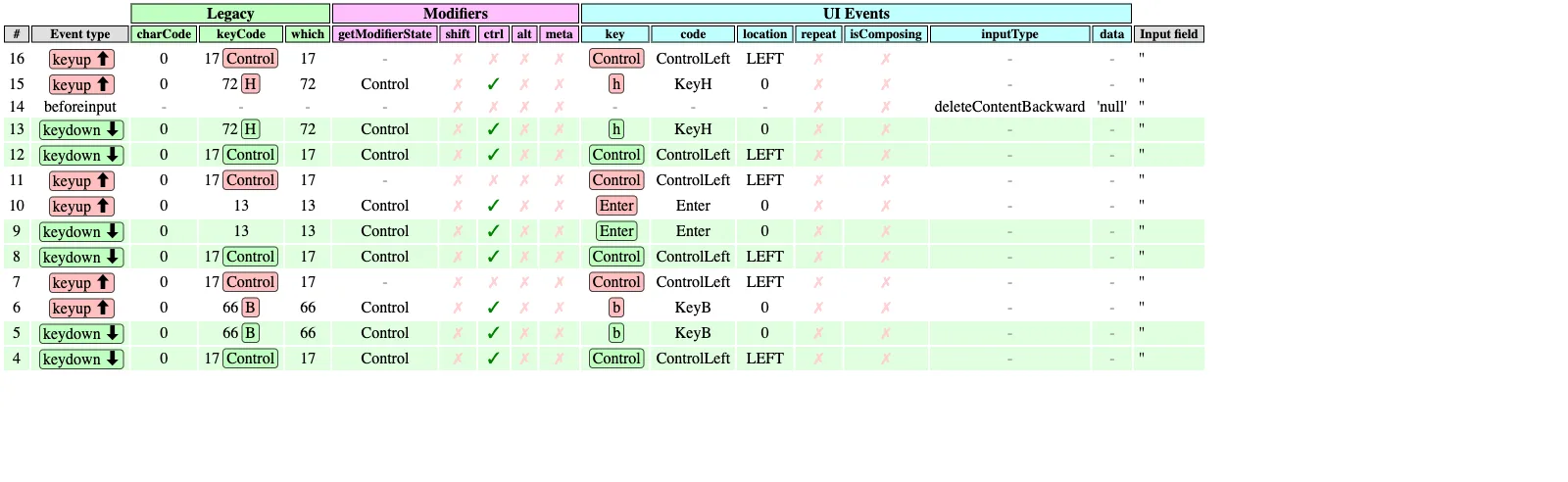
The W3C Keyboard Event Viewer logging Ctrl+B, Ctrl+Enter and Ctrl+H as normal browser key events, captured November 15, 2026. This is what a leaked overlay shortcut looks like to whatever has focus. InterviewMan's shortcuts do not produce these rows, because the operating system delivers them to the app and swallows them.
The third one is the test you can run yourself in thirty seconds. Open the W3C Keyboard Event Viewer, click inside the page, and press your tool's shortcuts. Rows mean the page received them. An empty table means the key press was consumed before the browser saw it. InterviewMan leaves the table empty.
How InterviewMan stays out of a Zoom share
InterviewMan is a native app for Mac and Windows with iPhone, Android and web apps that pair with it. On a Zoom call you can run it two ways, and both are included on every plan: Standard Mode, where an overlay sits on your screen but is excluded from capture, and Stealth Mode, where the laptop app hides itself and your phone shows the answers.
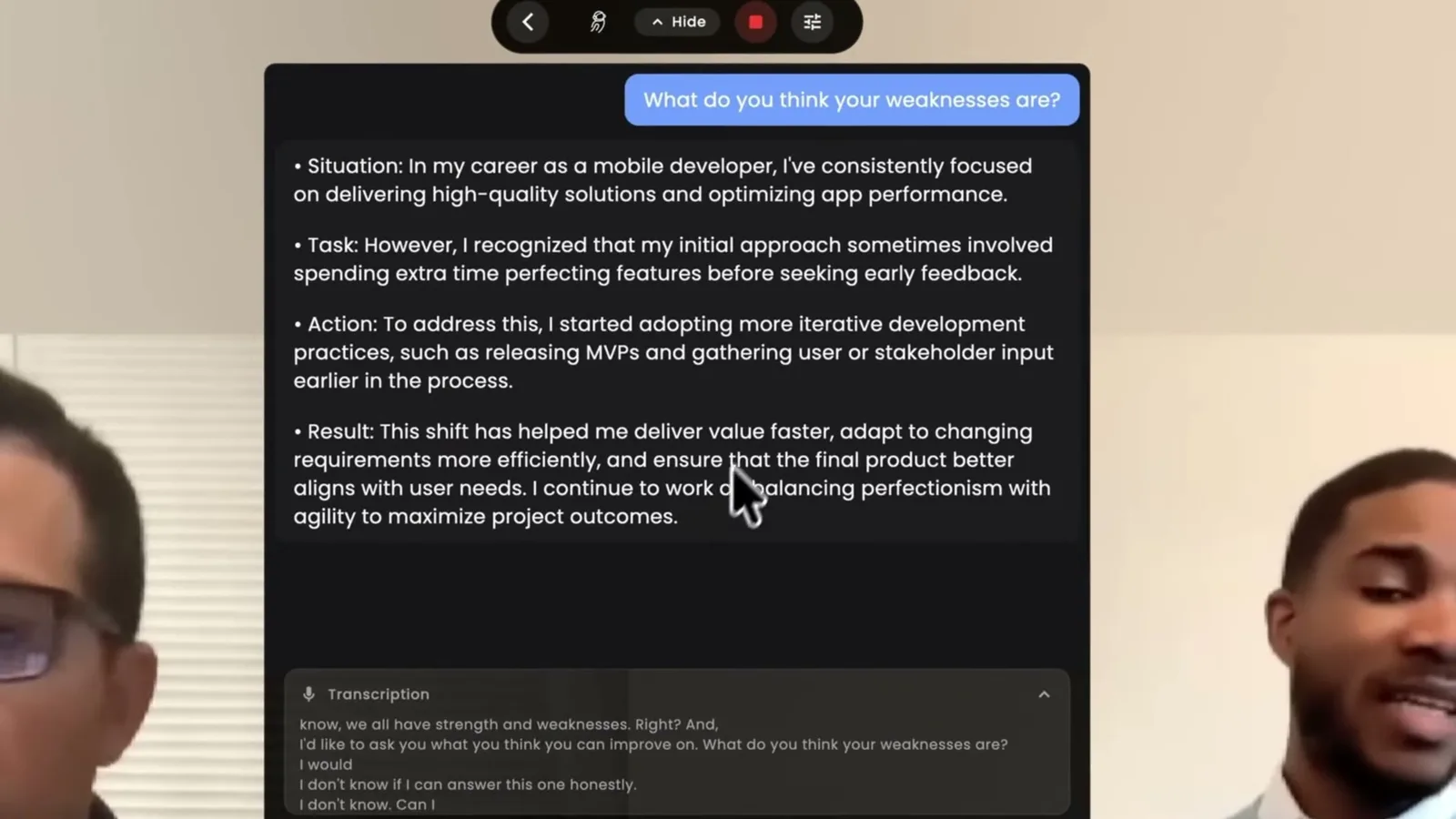
Standard Mode on a video call. The overlay shows a STAR answer to "What do you think your weaknesses are?" while the transcription keeps up with the interviewer. The window is excluded from screen capture, so a shared screen or a recording shows the call without it.
Windows: three layers, verified in the Zoom desktop client
Windows has an official way to keep a window out of screen capture, and InterviewMan uses it plus two more.
- SetWindowDisplayAffinity with WDA_EXCLUDEFROMCAPTURE. This is the Windows flag that tells the system a window must not appear in screen capture or recording. Capturers that use Windows Graphics Capture, the modern Windows capture path, get a blank where the window is.
- SetWindowCompositionAttribute with WCA_EXCLUDED_FROM_DDA. Some capturers use an older path called Desktop Duplication. This attribute excludes the window from that path too, so a browser-based share and an older recorder behave the same way.
- Chromium's content protection. The app's window layer also asks for content protection, which covers the one Windows 11 build where the first flag is refused by the system.
That third layer exists because of a real test. In July 2026 we installed the app on two Windows 11 virtual machines, one on build 21H2 and one on 24H2, started a Zoom meeting, and shared the whole screen. On 24H2 the first flag worked and the app was absent from the share. On 21H2 the system refused the flag, and the app was visible in the Zoom desktop client while still hidden from a browser share.
Adding content protection closed the gap: the next build was hidden in the Zoom desktop client on 21H2 as well, with the app fully visible on the real desktop and blacked out in Zoom's share preview. The current app carries all three layers, and the shows-when-sharing help page says the same thing in one line: the app works with current Zoom versions on Windows.
On the Zoom side, open Settings, then Share Screen, then Advanced, and set Screen capture mode to "Advanced capture with window filtering". This mode keeps Zoom's own windows out of the share and captures through the path the exclusion flags cover.
Two more Windows details matter on a call. The window is non-focusable: clicking it never takes focus away from Zoom or from the coding tool you are sharing, so nothing flickers. And the app is hidden from the taskbar, with a custom app name you can choose at install so Task Manager shows that name instead of InterviewMan.
Mac: the property, the exception, and the Stealth Mode answer
On macOS, InterviewMan sets its window's sharing type to "none". That is the AppKit property Apple provides so a window is left out of screen capture; password managers use it for the same reason. On macOS 13 or newer, ScreenCaptureKit, which is Apple's current capture system and the one current Chrome, Meet and Teams use, honours it. The app is also a background-only app, so there is no Dock icon and no Cmd+Tab entry, and its window is a non-activating panel: clicking it never activates the app, so the call never loses focus.
Here is the honest part. Newer versions of the Zoom desktop client on macOS have a problem with the screen-hidden feature, and the app may become visible during a full-screen share. Zoom's own community has a thread about windows that set this property behaving oddly in its Mac capture. The help center says it plainly: the workaround is Zoom 5.17.5 or older, and the team is working on a permanent fix. We do not give a date, because we do not have one.
So on a Mac Zoom call, our recommendation is not the overlay. It is Stealth Mode, where nothing about InterviewMan is on the shared screen at all. If you only need to share for a minute, Cmd+B hides the window before you click Share and brings it back after, and the hide itself does not move focus.
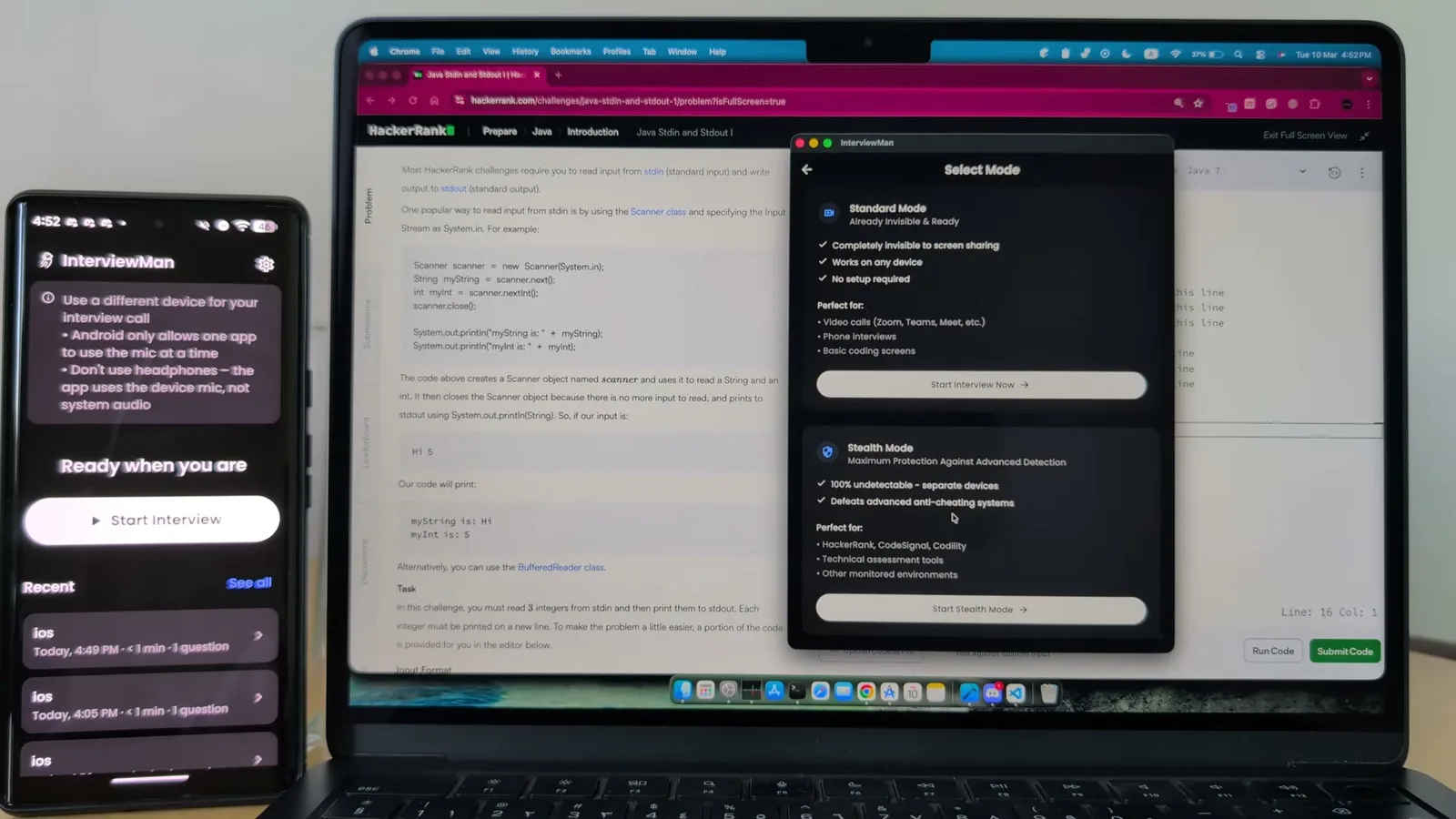
The mode picker. Standard Mode is the overlay. Stealth Mode moves the answers to the phone and hides the laptop app, which is the mode we recommend for Zoom on a Mac and for any proctored test.
Hidden on Zoom
Standard Mode keeps the overlay out of a full-screen Zoom share on Windows. Stealth Mode puts the answers on your phone with nothing on the shared screen. $12/mo on the yearly plan, 20-minute free trial, no card.
Download InterviewManStealth Mode: nothing on the shared screen
Pair the desktop app with the phone app or the web app once. The first pairing takes a few minutes, so do it the day before. On the call, click Start, choose Stealth Mode, and the laptop app hides itself completely. Its window is removed from the operating system's window list, which on a Mac is the list any screen-capture or monitoring software reads, and on the Mac direct-download build the process runs under a different name in Activity Monitor.
From then on the phone is the whole interface. It listens, detects questions and streams answers. If the interviewer pastes a coding problem, tap Screenshot on the phone and the laptop captures its screen and sends it over. Screenshots wait in a tray until you press Assist, so a long problem can be captured in two or three parts and read in order. When the call ends, Cmd+B or Ctrl+B brings the desktop window back.
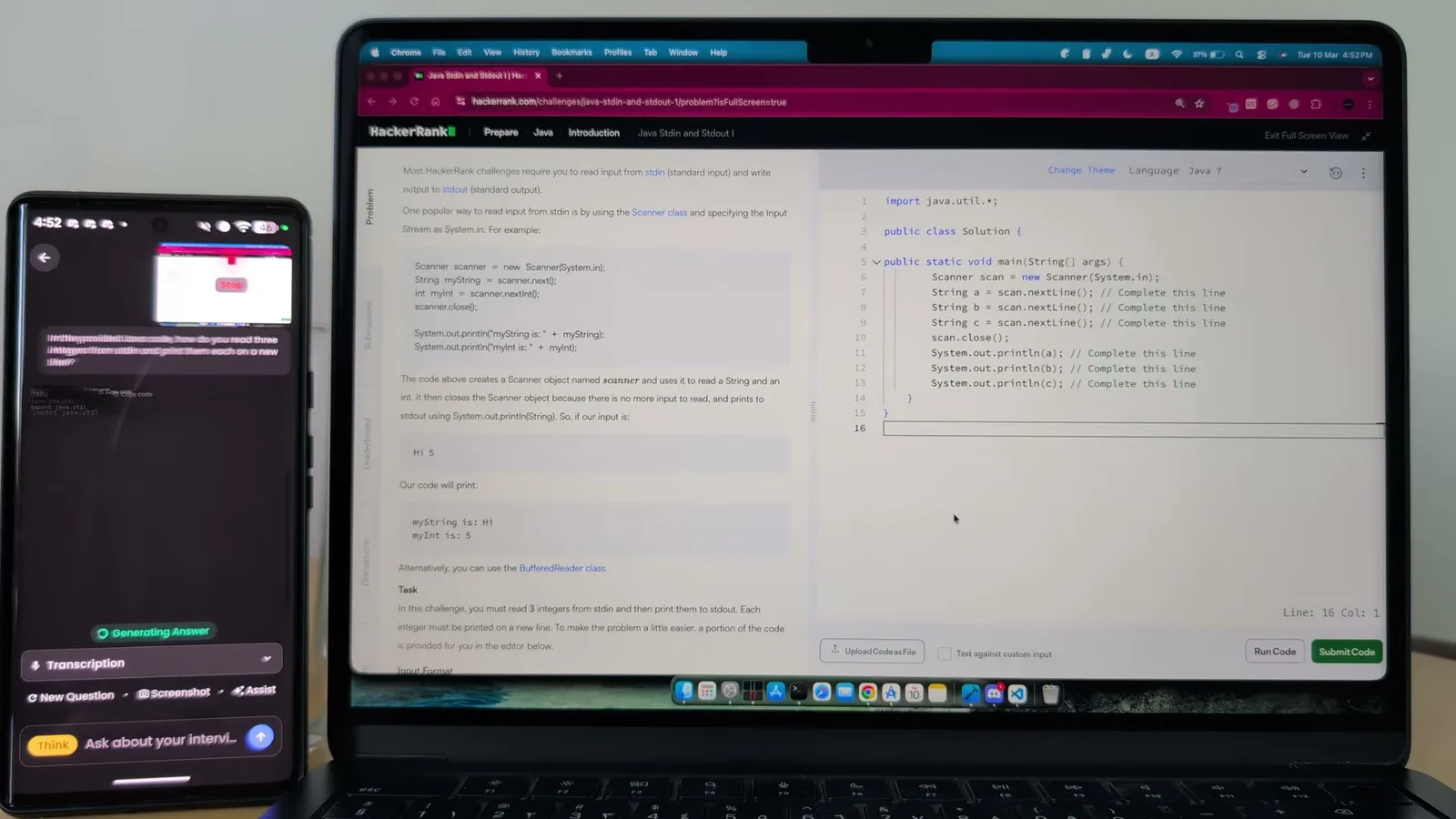
Stealth Mode on a coding task. The laptop screen is only the test, which is all a full-screen share can capture. The phone is generating the answer from a screenshot it requested.
Shortcuts that never reach Zoom
InterviewMan's shortcuts are registered with the operating system as global hotkeys, through RegisterHotKey on Windows and the system hotkey service on macOS. The system hands the key press to InterviewMan and swallows it. Zoom, the browser and any coding platform inside the call never receive it. That is why Cmd+H or Ctrl+H (screenshot), Cmd+Enter or Ctrl+Enter (generate), Cmd+B or Ctrl+B (hide or show), Cmd+I or Ctrl+I (mouse pass-through, so clicks go through the overlay), Cmd+L or Ctrl+L (start or stop the microphone) and Cmd+G or Ctrl+G (reset context) work while Zoom is the active window, without clicking the app first.
Cmd plus the arrow keys moves the window, and a transparency slider lets you fade it. The full list is on the keyboard shortcuts page.
How the tools compare on a Zoom call
| InterviewMan | Interview Coder | Cluely | Final Round AI | |
|---|---|---|---|---|
| Hidden in a full-screen share | Yes on Windows, verified in the Zoom desktop client on Windows 11 21H2 and 24H2; on a Mac with newer Zoom, use Stealth Mode | Claimed; its support page admits it can show in Google Meet on Windows 10 | Only on the plan that includes it | Claimed, on by default |
| Hiding included in the base price | Yes, on every plan | Yes | No: $149.99/mo monthly or $79.99/mo yearly for the plan with it | Yes |
| Second-device mode | Yes: Stealth Mode on iPhone, Android or the web app | No phone app | Desktop only | Phone screens "via another device" |
| Shortcuts stay out of the browser | Yes: system-level hotkeys, the viewer table stays empty | Not published | Not published | Not published |
| Price | $12/mo yearly ($144/yr) or $30/mo, 20-minute free trial, no card | $299/mo or $799 once | $149.99/mo with hiding | $25/mo yearly or $150/mo, no free live sessions |
| Refunds | 20-minute free trial before you pay | "No-refund policy for all purchases" | Detection by screen-sharing software is not refundable, per its terms | Not published |
Vendor claims and prices as checked on each vendor's site on November 6, 2026; check before paying. Full write-ups: Interview Coder, Cluely, Final Round AI. One more data point: Parakeet AI has a public user report of being detected in a Microsoft Teams entire-screen share on macOS, which is the same full-screen case that matters on Zoom.
The pattern in the table is that every vendor claims a hidden overlay, and only the price and the refund terms tell you who stands behind the claim. Cluely charges extra for it and will not refund you if it fails. Interview Coder refunds nothing at all. InterviewMan includes both modes on every plan and lets you test them on a mock Zoom call for twenty minutes before you pay anything.
Step by step: a Zoom interview with InterviewMan
- Pick the mode by computer. On Windows, Standard Mode is enough: the overlay is hidden from the current Zoom client. On a Mac, use Stealth Mode, or Cmd+B before a short share. Normal Mode vs Stealth Mode covers every case.
- On Windows, set Zoom's capture mode. Settings, Share Screen, Advanced, Screen capture mode: "Advanced capture with window filtering". Do this the day before, not during the call.
- Run a mock call. Open a Zoom meeting from a second account or a second device, share your whole screen, and look at it from the other side. On Windows you should see the call and your code with no InterviewMan window. In Stealth Mode you should see nothing at all. Then start a recording and watch that too.
- Sort out audio. On the laptop, turn on Device Audio to wear headphones; it is on by default in the Windows app, and in the Mac app on macOS 13 or newer and in the web app you switch it on. If you run the app on your phone instead, take the call on the laptop on speaker, keep the phone close, and wear no headphones on the phone. The headphones guide and hear the interviewer cover both.
- Park the window near the camera. In Standard Mode, use Cmd or Ctrl plus the arrow keys to put the overlay just under the webcam, so your eyes stay where the interviewer expects them. Turn on mouse pass-through with Cmd+I or Ctrl+I so a stray click lands in Zoom, not on the overlay.
- Keep the phone out of frame. In Stealth Mode, use a stand just below the webcam, a tablet, or a second laptop behind the first. Never pick the phone up during the call.
- Read, then speak. InterviewMan streams answers as bullet points. Glance, then say it in your own words. For coding questions, type the solution yourself in your own order; the app explains the approach and comments the code so you can.
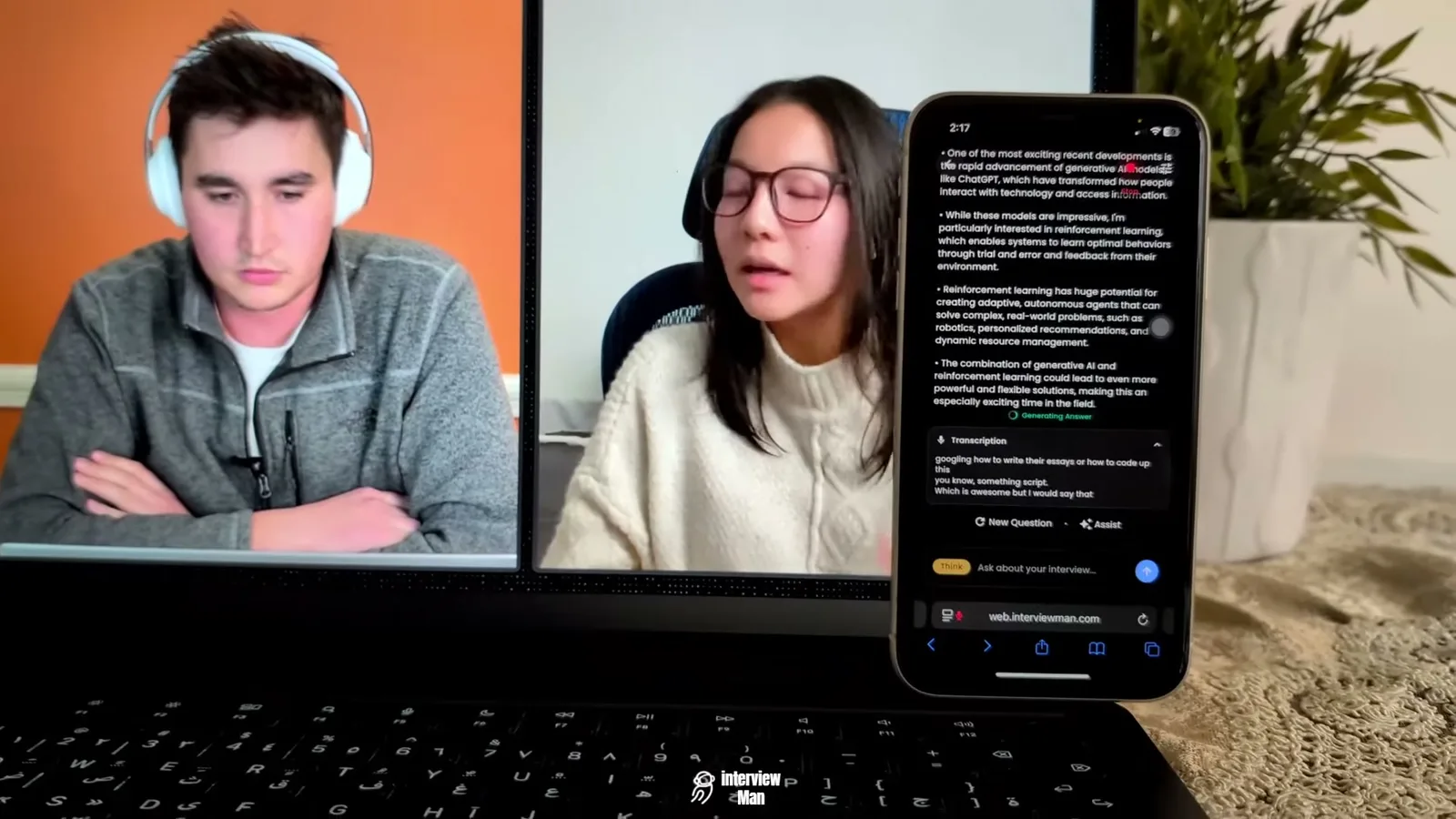
The phone-next-to-laptop setup. The call runs on the laptop, the phone listens through its own microphone and shows the answer. Nothing about the app is on the laptop screen.
What people report
Our reviews page collects every store rating and the Discord reports we were allowed to quote. The ones that involve a shared screen or a live camera are the relevant ones here:
- "Had a hackerrank screen sharing interview yesterday with Thomson Reuters. Passed with flying colors. InterviewMan installed on Windows OS, no pass-through enabled, simple standard mode with screenshots." (a Discord user, August 25, 2026)
- "Used interview on hackerrank with the built in video with three people watching me. Completely undetected and cleared the interview" (a Discord user, August 21, 2026)
- Asked whether Stealth Mode had been needed for two rounds of almost two hours each: "no Sir, didn't need it. Ran it on standard mode for 4 hours straight." (a Discord user, July 2026)
- One practical warning for Google Meet users that applies to any call: "Amazing product, worked out of the box. Just a word of caution to people using it with Google meet, remember to disable studio quality option inside google meet settings, else InterviewMan wont be able to use the mic." (a Discord user, May 31, 2026)
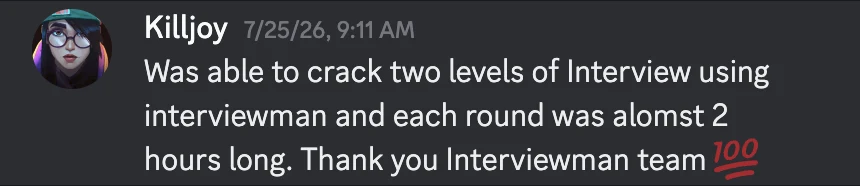
Two interview rounds of almost two hours each, as posted in the InterviewMan Discord.
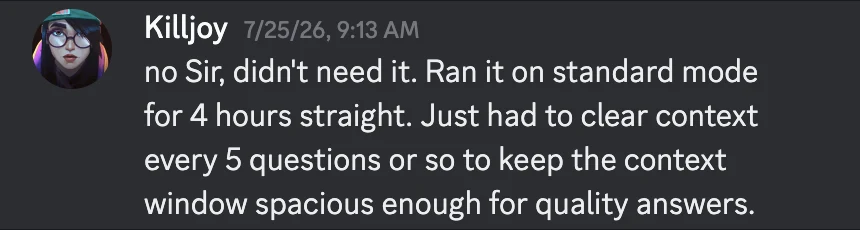
The follow-up when asked whether Stealth Mode was needed: four hours in Standard Mode.
Across its users InterviewMan has zero confirmed detections, and it is rated 4.9 on both the App Store and Google Play. A track record is not a guarantee, which is why the next section exists.
What no tool can fix
- A phone in the camera. Stealth Mode keeps the app off the shared screen. It does not make a phone invisible to a webcam. Keep it out of frame or use a second laptop.
- A 360-degree room scan. If the interviewer asks you to turn the camera around, a second device on the desk is in the recording.
- Reading instead of talking. Eyes that track a line of text look like eyes that track a line of text. Glance at bullets and speak.
- Pasted code. InterviewMan never types or pastes for you, by design. If you paste a block into a shared editor, the interviewer watches it appear.
- The Mac Zoom gap in Standard Mode. Until the fix ships, a Mac with a current Zoom client and the overlay on screen is the one setup we do not recommend. Use Stealth Mode there.
- Network traffic. InterviewMan does not hide its network traffic. Zoom does not inspect it, but a company laptop with monitoring software might.
Zoom shows what you share and records what it shows. A tool that is excluded from capture, silent to the keyboard, and off the shared machine covers that. The camera and your own behaviour are still yours.
Frequently asked questions
Does Zoom detect screen recording or screen capture software?
No. Zoom has no documented feature that detects recording software, screen-capture tools or AI assistants running on a participant's computer, and it has made no public statement about detecting AI interview tools. What Zoom does is send the screen you share to the other participants and include it in any recording, so the only question that matters is whether a window is in that shared stream.
Can the interviewer see my other windows on Zoom?
Only if you share the entire screen, and only the windows that the operating system includes in capture. A window share sends one window. An entire-screen share sends everything on that display except windows excluded from capture, which is how InterviewMan's overlay stays out while the rest of your screen goes through.
Does Zoom detect AI interview tools on a Mac?
Zoom does not detect them, but on a Mac the screen-hidden feature has a known problem with newer Zoom versions, so an overlay can become visible in a full-screen share. The workaround is Zoom 5.17.5 or older. The better answer is Stealth Mode: the laptop app hides itself and the answers go to your phone, so there is nothing on the shared screen for any Zoom version to capture.
Does InterviewMan show up in a Zoom recording?
No, when the window is excluded from capture it is absent from the live share and from the recording, because the recording is made from the same captured stream. On Windows that is verified in the current Zoom desktop client on Windows 11. On a Mac with a newer Zoom client, use Stealth Mode, where the app is not on the screen at all.
Does Zoom know which apps I have open?
No. Zoom has no feature that lists a participant's running processes, window titles or browser extensions, and its bot controls only concern things that try to join the meeting. InterviewMan never joins a meeting, never appears in the participant list and is hidden from the Dock, Cmd+Tab and the Windows taskbar, so there is nothing for an interviewer to ask you to show.
Is it safer to share a window instead of the whole screen?
Yes, if the interviewer lets you choose, a window share sends only that window. Most technical interviewers ask for the entire screen, so plan for that case: on Windows, InterviewMan's overlay is excluded from an entire-screen share; on a Mac, use Stealth Mode. Test it on a mock Zoom call with the 20-minute free trial before the interview that matters.
Download: InterviewMan for Mac, Windows, iPhone, Android and web ($12/mo on the annual plan or $30/mo, with a one-time 20-minute free trial and no card)
Hidden on Zoom
Standard Mode keeps the overlay out of a full-screen Zoom share on Windows. Stealth Mode puts the answers on your phone with nothing on the shared screen. $12/mo on the yearly plan, 20-minute free trial, no card.
