

An interview copilot is software that listens to a live job interview, works out what you were just asked, and puts a suggested answer on your screen while the interviewer is still talking. It is not practice software and it is not a coach. It runs during the real thing.
Key takeaways:
- An interview copilot has four moving parts: audio capture, streaming transcription, question detection, and answer generation. Every product in this category does the same four things. What separates them is latency, coverage, and whether the overlay survives a screen share.
- Latency is the feature that matters most. Under two seconds reads as thinking. Past four or five seconds reads as looking something up.
- A copilot is a different product from a mock-interview tool and a different product again from a teleprompter, even when one vendor sells all three.
- Prices for a live copilot in September 2026 range from $12 per month (InterviewMan on annual billing) to $150 per month (Final Round AI month to month), and the billing period behind a headline number matters more than the number itself.
- Session caps are the most commonly missed detail. "Unlimited sessions" and "unlimited session length" are not the same sentence. Verve AI caps Pro sessions at 90 minutes, LockedIn AI caps an interview at 2 hours, and we cap neither on paid plans.
- There are rounds where a copilot is the wrong tool: in-person interviews, locked-down proctored clients, employer-issued hardware, and any conversation where you already know the answer cold.
A note on who wrote this: InterviewMan is ours, and it is number four in the list below. We have linked the source page for every competitor figure, including the ones that make us look worse, so treat the ranking as an argument you can audit rather than a verdict.
Last tested: September 17, 2026. Prices checked on each vendor's pricing page on that date.
What an interview copilot actually is
The word is borrowed from coding assistants, and the analogy holds. A coding copilot suggests the next lines while you type. An interview copilot suggests the next thing to say while you talk.
Three properties define the category:
Ready to ace your next interview?
InterviewMan gives you real-time AI answers during live interviews — undetectable on Zoom, Meet, and Teams.
Try InterviewMan FreeIt runs live. During the call, not before it and not after it. Anything that only helps you rehearse is a preparation tool, however good it is.
It is one-way. The copilot does not speak, type, or submit anything. It writes on your screen, you decide what to do with it. Every product in this roundup works this way.
It is private to you. The interviewer is not supposed to see it. That requirement is why most serious copilots are native desktop apps rather than browser extensions, and it is the single biggest source of product differences in this market.
If you want the technical detail on how the "private to you" part works at the operating system level, we wrote it up separately in stealth interview AI: how it works. This guide is about the copilot itself.
How an interview copilot works, step by step
Under the marketing, all of these products run the same five-stage pipeline.
1. Audio capture. The microphone, or the system audio output, picks up the interviewer. Microphone capture works everywhere and picks up room noise. System audio capture is cleaner but needs deeper permissions, and on macOS some tools require a third-party audio driver to get it, which is itself a thing a proctoring client can see.
2. Streaming transcription. Speech to text, running continuously rather than in chunks. This is where a copilot either earns or loses its latency budget. A system that waits for a natural pause before transcribing has already spent a second it will never get back.
3. Question detection. The hard part. The transcript is a stream of conversational text, and somewhere in it is an actual question. A good detector separates "so tell me about a time you disagreed with your manager" from "so, how's your morning going". InterviewMan exposes three sensitivity levels for this, because an aggressive detector fires on small talk and a conservative one misses a question phrased as a statement.
4. Answer generation. The detected question goes to a language model along with your profile, your resume, the role, and your answer settings. Settings matter more than most people expect: a copilot that returns 150 words when you needed 40 has handed you something unusable in real time. InterviewMan supports STAR, CAR, SOAR, PAR, and SOARA structures, three length bands, and separate interview and answer languages across 40+ languages.
5. Streaming display. The answer appears word by word as it is generated, not in one block at the end. This is not cosmetic. Streaming means the first useful phrase reaches your eyes one to two seconds after the question ends, while a system that waits for the full response adds however long generation takes to your silence.
Most copilots also accept two other inputs besides audio: a manual screenshot, analyzed by a vision model, for a coding problem or a diagram that was never read aloud, and direct typed text. The screenshot path is the one that saves technical rounds, because in a CoderPad or HackerRank session the question is often on screen and never spoken.
Latency: the number that decides whether a copilot is usable
Everything above collapses into one measurement: how long between the interviewer's last word and the first useful word on your screen.
Rough bands, from watching people use these tools:
- Under 2 seconds. Indistinguishable from thinking. A normal candidate pauses this long before a behavioral answer anyway.
- 2 to 4 seconds. Usable if you fill it. Start with a clarifying question or repeat the question back, and the gap disappears.
- Over 5 seconds. The interviewer notices. Silence on a video call feels roughly twice as long as it is, and five seconds of dead air after a normal question is an event.
Three design choices drive the number. Streaming transcription versus batch. Streaming display versus wait-for-completion. And model tier, which is the trade-off nobody advertises: the strongest model on a vendor's list is usually not the fastest one. LinkJob AI is unusually open about this, listing the exact models per plan on its pricing page, where the cheaper tiers get the lighter and faster models.
The practical move is to stop optimizing for a perfect answer. You do not need 150 words. You need the first clause and the structure, then you talk. Which brings us to the thing that actually gets people caught.
Ready to ace your next interview?
InterviewMan gives you real-time AI answers during live interviews — undetectable on Zoom, Meet, and Teams.
Try InterviewMan FreeInterview copilot vs mock interview tool vs teleprompter
These three get sold together and confused constantly.
A mock interview tool asks you questions and scores your answers. It runs before the interview. Its value is repetition and feedback: you find out that your Amazon story has no metrics in it while there is still time to fix that. Pramp and Interviewing.io are the human versions, and most copilot vendors bundle an AI version. We cover the practice side in mock interview practice with AI and the broader plan in our interview prep guide.
A teleprompter shows you text you wrote in advance. It is fully under your control, it never invents anything, and it is useless the moment you are asked something you did not anticipate.
A copilot generates in response to what was actually said. It handles the unanticipated question, which is exactly what the other two cannot do, and it introduces the two problems they do not have: it can be wrong, and reading it aloud is obvious.
The failure mode worth naming: people who read a copilot's output word for word get caught, and not by software. A recited answer has a different rhythm, a different vocabulary, and a strange smoothness compared to how the same person spoke thirty seconds earlier. The skill is to glance at the screen, take the structure and the first concrete noun, and then say the rest in your own voice. If you cannot do that yet, a copilot will hurt you.
Most people need all three at different stages: mock interviews in week one, a story bank in week two, and a copilot in the live round for the questions you did not predict. Our AI mock interview page covers running practice and live help through one tool.
The 6 best interview copilots in 2026
Selected because each publishes a live-copilot product, names a price, and is actually bought by candidates. Every price below comes from the vendor's own page, checked on September 17, 2026.
1. Final Round AI: the widest product surface around the copilot
Final Round AI sells the largest bundle in this list. The copilot sits inside a suite that also covers resume work, application tooling, and preparation, and its pricing page is explicit that the Pro plan "Unlocks live CoPilot, Stealth Mode and every interview type", with Stealth Mode on by default.
Pros
- Genuinely broad. If you want your resume, your applications, and your live interview help from one subscription, this is the most complete option here.
- Stealth Mode is included with the copilot rather than sold as a separate tier, which is not true of Cluely.
- Every interview type is covered on Pro, not just coding.
- A real free plan for the preparation tools, so you can evaluate the non-live half at no cost.
Cons
- The main pricing page shows the Pro plan as "$25+/mo", which is the annual rate. The real month-to-month rate is on a second page, finalroundai.com/subscription-simple, and it is $150.00 per month. That is a six times gap between the number on the marketing page and the number a monthly buyer pays.
- Their own blog post on Final Round AI pricing still quotes $90 per month, which no longer matches their checkout. When a vendor's own two pages disagree, trust the subscription page.
- No free trial of the live copilot. The page states plainly that live sessions need an active Pro subscription, so evaluating the part you are buying it for means paying first.
- The refund terms are narrower than they first look. There is a 72-hour money-back guarantee, but only on first-time quarterly and yearly purchases, and the terms add a usage test: fewer than 2 interview sessions each strictly over 30 minutes. The FAQ and the terms also contradict each other on whether renewals qualify, so a renewal refund is a coin toss.
- The breadth cuts both ways: a candidate who only wants live interview help is paying for resume and application tooling they will not open. Full comparison at InterviewMan vs Final Round AI.
Price
Free plan at $0. Month to month is $150.00. Quarterly billing works out at $83.33 per month and yearly billing at $25.00 per month, with a "Premium MAX" tier at $41.67 per month billed annually. Verified on finalroundai.com/subscription-simple on September 17, 2026.
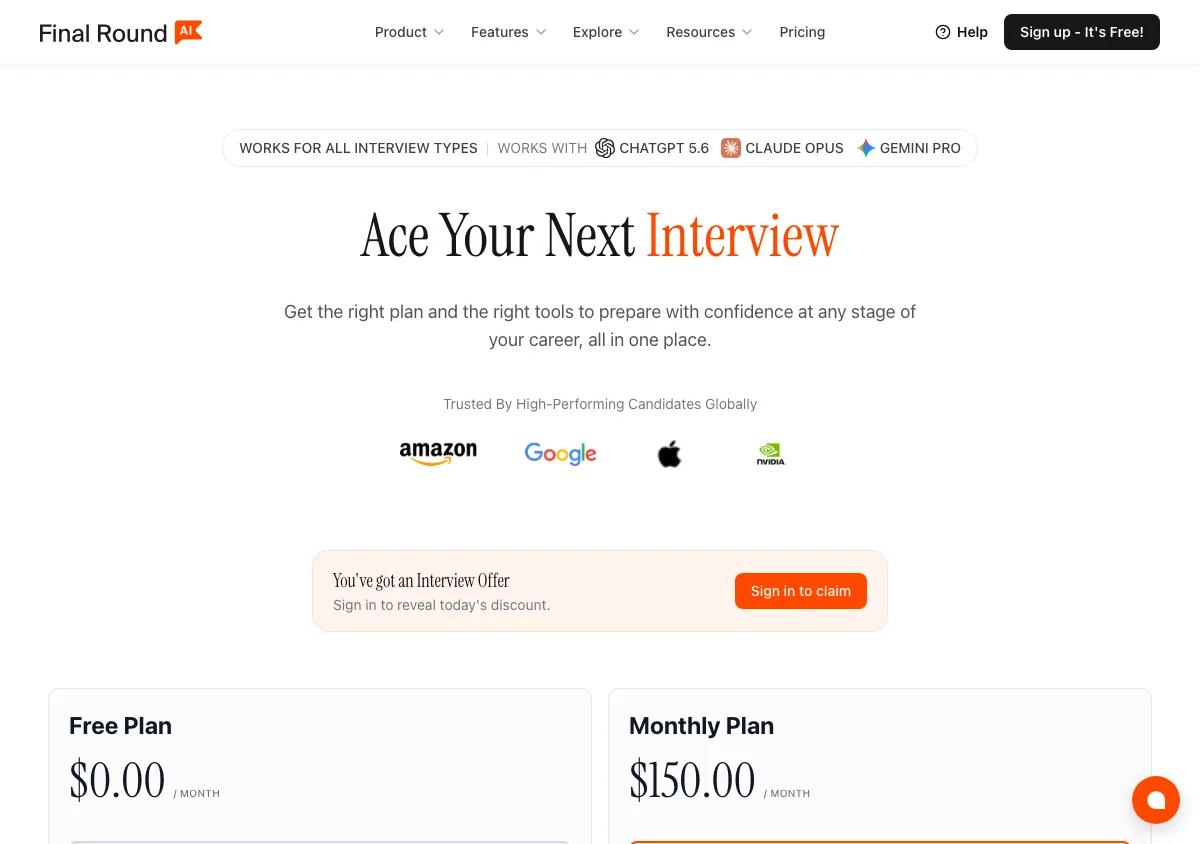
Final Round AI pricing page, captured September 17, 2026. Plans and prices can change; check the vendor's page before buying.
2. LockedIn AI: the copilot built for technical rounds
LockedIn AI splits its product into an interview copilot, a coding assistant, an online assessment helper, and mock interviews, rather than pointing one generic overlay at everything. For a loop that is mostly algorithms and assessments, that structure is a real advantage.
Pros
- Purpose-built surfaces for coding rounds and online assessments, which handle a problem statement better than a general conversational copilot.
- Multiple model providers available, useful when one model is stronger in the language you are being tested in.
- The per-interview cap is now up to 2 hours, which is long enough for a system design round plus overrun.
- A pay-per-use path exists: $69.99 a month buys 400 Copilot minutes, or 800 minutes of mock practice, which is a better shape than a subscription if you have two interviews rather than a six-month search.
- Mock interviews are bundled, so practice and live help sit in one subscription.
Cons
- The copilot tier and the stealth tier are different purchases. General (Unlimited) is $54.99 month to month, or $39.99 per month when you pay for three months at a time. Stealth Mode and LockedIn Duo are Professional features, at $119.99 per month or $79.99 per month quarterly. A lot of roundups quote $39.99 as if it were the monthly price of the whole product. It is neither monthly nor the stealth tier.
- The money-back guarantee badge overstates what you get. Under the refund policy, monthly and quarterly plans cannot be refunded once started, and annual plans get a partial refund only inside 7 days.
- Credit minutes are consumed by the copilot in real time, so a slow interviewer costs you the same minutes as a fast one. That makes a long loop harder to budget than a flat subscription.
- Behavioral and recruiter rounds get less product attention than the coding surfaces. Detail at InterviewMan vs LockedIn AI.
Price
General (Unlimited) is $54.99 per month, or $39.99 per month billed every three months at $119.97 per charge. Professional, which is where Stealth Mode and Duo live, is $119.99 per month or $79.99 per month billed quarterly. Credits are $69.99 per month for 400 Copilot minutes, and there is a $999.50 one-time Lifetime Pro tier. Verified on lockedinai.com/pricing on September 17, 2026.
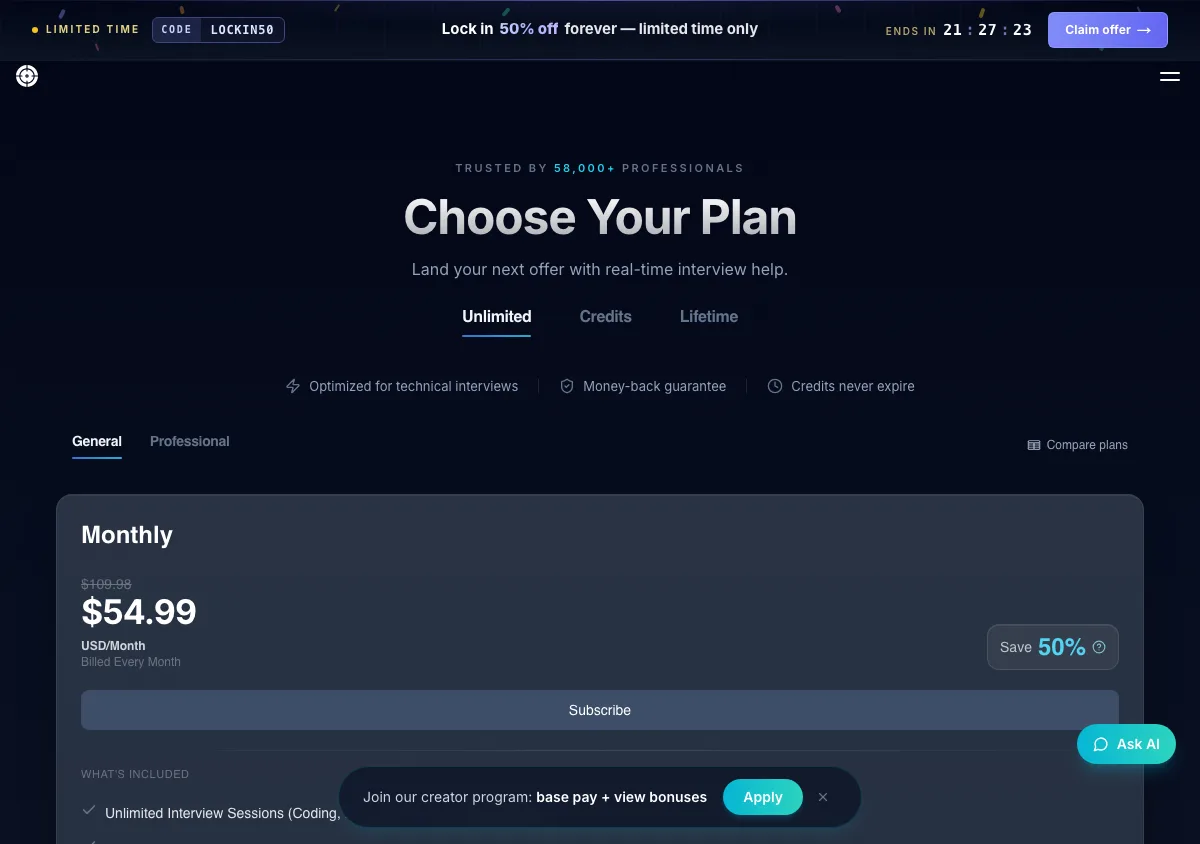
LockedIn AI pricing page, captured September 17, 2026. Plans and prices can change; check the vendor's page before buying.
3. LinkJob AI: the only one that tells you which model you are buying
LinkJob AI's most useful decision is publishing the exact model roster per tier instead of saying "the latest AI models". If you care whether your answer came from a frontier model or a fast small one, this is the only product here that answers the question before you pay.
Pros
- Model transparency by tier. The yearly plan lists a named roster including GPT-5.6 Sol, Claude Opus 5, Gemini 3.1 Pro, and Grok 4.6, while the monthly plan is openly restricted to lighter models.
- You can try the copilot before paying, and the trial grows with each step: half an hour on download, and 45 minutes if you join their Discord or WhatsApp community.
- Support runs through a live community channel as well as an inbox, which matters when a copilot misbehaves sixty minutes before a round.
- A $999.99 lifetime option for candidates who expect a long search.
Cons
- Month to month it is $99.99, second only to Final Round AI in this list, and the advertised $29.99 per month means handing over $359.88 before your first interview.
- Monthly plans are non-refundable by their own terms. The money-back guarantee applies only to first-time quarterly and yearly purchases, and renewals and upgrades are excluded.
- The cheapest tier buys the weakest models, which is the honest cost of the transparency, and the weakest models are usually the fastest ones. Speed and quality point in opposite directions on this plan ladder. See InterviewMan vs LinkJob AI.
Price
Monthly is $99.99. Quarterly billing drops it to $69.99 per month, charged as $209.97, and yearly billing to $29.99 per month, charged as $359.88. A one-time lifetime licence is $999.99, and it is the only tier that unlocks the full model roster. Verified on linkjob.ai/pricing on September 17, 2026.
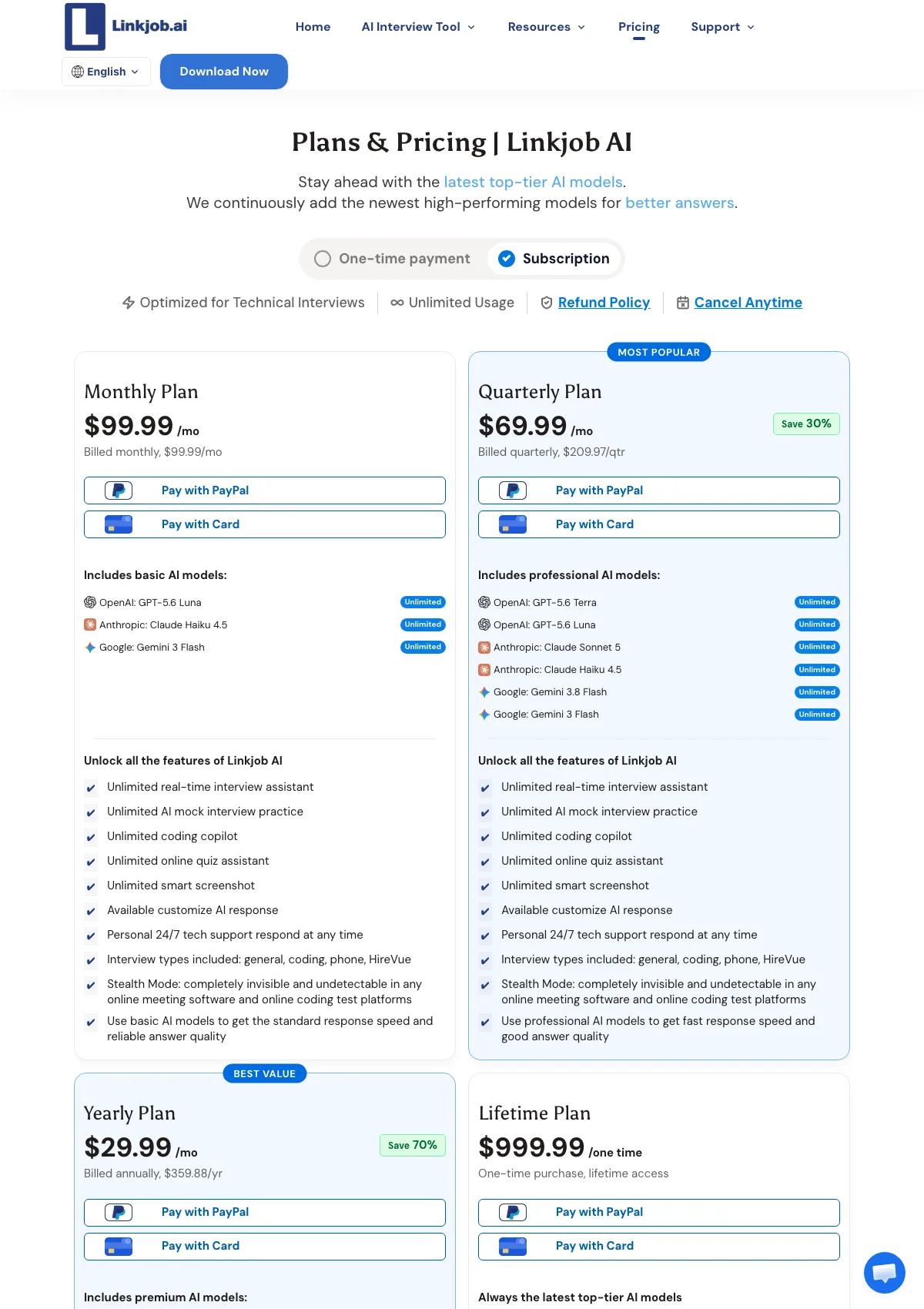
LinkJob AI pricing page, captured September 17, 2026. Plans and prices can change; check the vendor's page before buying.
4. InterviewMan: the cheapest copilot with no session cap
Our product. InterviewMan is an interview-only copilot: no resume builder, no job board, no auto-apply. It listens, detects the question, and streams an answer, with a two-device Stealth Mode for the rounds where an overlay on the interview machine is the wrong idea.
Pros
- $12 per month on annual billing, the lowest price in this list, verified on our pricing page.
- No session length cap and no session count cap on paid plans, which removes the failure mode that LockedIn AI and Verve AI both have.
- Answer control that matters live: STAR, CAR, SOAR, PAR, and SOARA structures, short answers at 30 to 50 words for rapid-fire rounds, and 40+ languages with separate interview and answer language settings.
- Five platforms: macOS, Windows, iOS, Android, and the web client, all listed on the download page.
- Screenshot capture with a vision model for problems that are on screen and never spoken, which is most coding rounds.
- Company-reported 4.9/5 from 4025 reviews and 570,000+ users, with zero confirmed detections reported. Those are our own numbers rather than an audited figure, and the detection count is a track record, not a technical guarantee.
Cons
- Interview-only. If you want resume rewriting and application tooling in the same subscription, Final Round AI covers more ground than we do.
- We do not publish which models power each tier. LinkJob AI does, and if that is your deciding factor, that is a real gap on our side.
- Stealth Mode needs a second device and a pairing step done before the call. Unrehearsed, the first run is clumsy, and glancing at a phone is a behavior an attentive interviewer can read.
- No auto-fill, no code execution, no scoring. The copilot shows you an answer and stops there.
- Network traffic is not hidden, so employer-issued hardware is out of scope.
Price
$30 per month month to month, or $12 per month billed annually at $144 per year, plus a free trial with limited minutes and no credit card required. Students who verify get 25 percent off the yearly plan, which is $108 per year, and 10 percent off monthly, through our student discount page. Verified on interviewman.com/pricing on September 17, 2026.
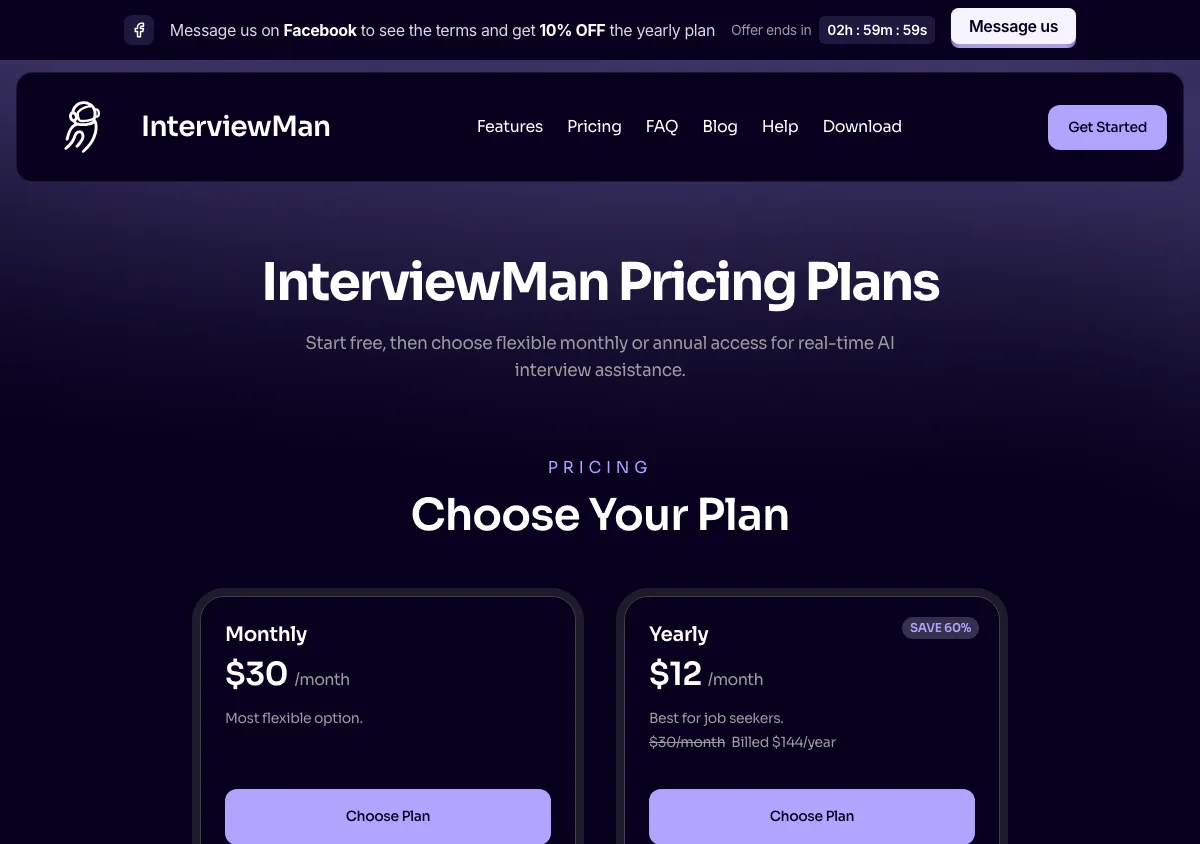
InterviewMan pricing page, captured September 17, 2026. Plans and prices can change; check the vendor's page before buying.
5. Verve AI: the clearest free tier for trying a copilot at all
Verve AI is worth including because its free plan actually includes live copilot sessions, which is rare. Its pricing page publishes the plan structure in unusual detail, and it ships a desktop app for Mac, Windows, and iPhone rather than being browser-only.
Pros
- The free plan includes three live Interview Copilot sessions and five AI mock interviews, so you can test the live product before paying. Almost nothing else here lets you do that.
- Plan limits are published precisely: 15-minute sessions on Free, 60-minute sessions on Standard, 90-minute sessions on Pro. That is more honest than "unlimited" with a footnote.
- Unlimited mock interviews from the Standard plan up, plus interview reports, which makes it a reasonable practice tool in its own right.
- Pro adds a coding solver and an assessment copilot for technical rounds.
Cons
- Session caps everywhere. Even Pro tops out at 90 minutes per session, and Standard allows only 5 copilot sessions per month, which a single busy interview week can exhaust.
- We could not verify a price for Standard or Pro at the time of writing. Third-party figures circulate, but none of them trace back to the vendor's own page, so we are not quoting one. Get the number from checkout before you commit.
- Its historical positioning is browser-first, and a browser extension cannot be excluded from a screen capture. Confirm you are running the desktop app, not the extension, before a shared-screen round. See InterviewMan vs Verve AI.
- The refund policy is a separate linked page rather than stated on the plan cards.
Price
A free plan is available. Standard and Pro pricing was not verifiable at the time of writing, so check the figure at checkout on vervecopilot.com/pricing rather than trusting a republished number.
6. Beyz: the best mid-price bundle if you buy six months
Beyz sells a desktop copilot plus mock interviews and phone-interview support, and its homepage leads with "Desktop app. Invisible to screen sharing", claiming the overlay stays hidden from Zoom, Meet, Teams, and screen recorders.
Pros
- The semi-annual Titan plan at $24.99 per month is a reasonable rate for unlimited AI assistants and expanded file uploads, and it is the cheapest way into this product by a wide margin.
- Desktop app for Apple Silicon, Intel Mac, and Windows x64, plus a browser-based web app, so the capture-exclusion path is architecturally available.
- Phone interview support is included on all plans, which most competitors here do not offer at all.
- Mock interviews and preparation tools come with every tier rather than being a separate purchase.
Cons
- The month-to-month plan at $49.99 does not support the coding assistant and limits you to 5 AI assistants, so the cheapest way to try it is also the least capable version.
- The real prices require commitment: Titan is billed semi-annually and God is billed quarterly. There is no cheap monthly path to the full feature set.
- The pricing lives on the homepage and a direct /pricing URL returned a 404 for us, which makes the plan terms harder to audit than they should be.
- Its browser extension is easier to spot during a screen share than a native overlay, so plan selection and app choice both matter. Detail at InterviewMan vs Beyz AI.
Price
$49.99 per month monthly, $24.99 per month on the Titan plan billed semi-annually at $149.94, and $32.99 per month on the God plan billed quarterly. Verified on beyz.ai on September 2, 2026.
Interview copilot comparison table
Two columns decide most purchases in this category: what kind of copilot you are actually buying, and what it costs on the cheapest billing period each vendor offers. Monthly rates, refunds, and caps are in the sections above.
| Copilot | Copilot type | Price on the longest billing period |
|---|---|---|
| Final Round AI | Career suite with a live copilot inside it: resume, applications, prep, then the call | $25.00 per month billed yearly, or $41.67 per month for Premium MAX |
| LockedIn AI | Technical specialist, split into copilot, coding, assessment, and mock surfaces | $39.99 per month billed quarterly on General; $79.99 per month quarterly if you need the Professional stealth tier |
| LinkJob AI | Model-transparent desktop copilot: you choose the tier by which models it runs | $29.99 per month billed yearly ($359.88), or $999.99 once for lifetime |
| InterviewMan | Interview-only copilot with a two-device mode and no session cap | $12 per month billed yearly ($144), or $108 per year for verified students |
| Verve AI | Free-tier-first copilot with published per-session minute limits | Not verifiable at the time of writing; the free plan includes 3 live sessions |
| Beyz | Bundle copilot: live help plus mock interviews and phone-interview support | $24.99 per month on the semi-annual Titan plan ($149.94) |
Read that middle column before the right-hand one. A career suite and an interview-only copilot are not competing products, and the cheapest of them is not the best buy if half of what you are paying for is a resume builder you will open twice.
When an interview copilot is a bad idea
We sell one, and there are still rounds where we would tell you not to open it.
In-person interviews. There is no screen to hide anything on. This entire category applies to remote interviews only.
Employer-issued hardware. No copilot hides network traffic. On a company laptop, a company VPN, or a managed device, the API calls are visible regardless of what the window is doing. Do not.
Locked-down proctoring clients. HackerRank's test integrity documentation describes a desktop app mode that adds, in their words, "operating system-level monitoring to create a fully locked-down environment". When you are told to install a proctoring client, an overlay on that same machine is the wrong tool. A second device is the only remaining option, and even then the eye-movement problem is yours to solve.
Questions you already know cold. Reading a generated answer to "tell me about yourself" is strictly worse than the version you rehearsed. The copilot earns its money on the question you did not predict, not the four you did.
Any round where you cannot paraphrase in real time. If you are going to read it out, do not use it. That is the tell, and no product feature fixes it.
Where the policy forbids it. Company rules vary widely and are changing fast. We track the current picture in which companies allow or ban AI in interviews, and the broader argument sits in should you use AI in a job interview in 2026?. Read the interview invitation before you decide.
How to use an interview copilot without sounding like one
Six habits separate people who get value from this from people who get rejected by it.
- Load your real resume first. A copilot with no profile invents plausible experience. A copilot that has inflated your numbers, saying you led twelve people when your resume says four, hands the interviewer a contradiction they can see on the document open in front of them.
- Set answers short. 30 to 50 words is a structure and an opening clause. 150 words is a script you will be tempted to read.
- Buy yourself the two seconds. "Let me make sure I understand the question" is a normal thing candidates say and it covers the entire latency window.
- Glance, then look back at the camera. Take the structure, drop your eyes for under a second, and deliver to the lens.
- Rehearse with it before it counts. Run at least two mock sessions with the copilot on. The first time you use one live should not be the first time you have used one.
- Be ready to close it. If the copilot is wrong or slow, abandon it mid-answer and talk. A candidate who says "I would want to check that assumption" recovers. A candidate waiting on a screen does not.
Which copilot we would pick
If you want resume tooling, applications, and a copilot in one bill, Final Round AI is the widest bundle here and Stealth Mode comes with the Pro plan rather than being upsold. Buy it on the yearly plan at $25.00 per month, though. Month to month it is $150.00.
If your loop is mostly coding and assessments, LockedIn AI's dedicated surfaces are the best fit, and the 2-hour per-interview ceiling clears any round you are likely to sit. Price the Professional tier, not the $39.99 quarterly headline, if you need its Stealth Mode.
If model choice is what you are buying, LinkJob AI is the only product in this list that tells you which models you get, and that is a legitimate reason to pick it over us.
If you want to test a live copilot before spending anything, Verve AI's free tier includes actual copilot sessions, which almost nothing else does.
We would pick InterviewMan when the search runs across recruiter screens, behavioral rounds, coding, and system design, when a long session is likely, and when $12 per month against $99.99 per month is a difference that matters. That is our bias, with every competing price above so you can check the arithmetic yourself.
Frequently asked questions
What is an interview copilot?
An interview copilot is software that runs during a live job interview, transcribes what the interviewer says, detects the question, and streams a suggested answer to your screen in real time. It does not speak or type for you: it writes, and you decide what to say. It is different from a mock interview tool, which runs before the interview and scores your practice answers.
How does an interview copilot work?
Five stages run continuously: audio capture from your microphone or system audio, streaming speech-to-text transcription, question detection that separates real questions from small talk, answer generation using your profile and settings, and streaming display so the first words appear while the rest is still being written. Most copilots also accept a screenshot for problems that are on screen but never spoken aloud.
Can the interviewer see an interview copilot on my screen?
Not if the copilot is a native desktop app using operating system capture exclusion, because video platforms send whatever the capture API returns and the excluded window is not in it. A browser extension is a different story: it draws inside the browser window that gets shared, so it appears in the feed. Confirm which one you are running before a shared-screen round.
How fast does an interview copilot need to be?
Under two seconds from the end of the question to the first useful words on your screen is the target, because that is indistinguishable from a normal thinking pause. Two to four seconds is workable if you fill the gap by restating the question. Past five seconds the silence is noticeable on a video call, and a slower answer from a stronger model is usually the worse trade.
What is the difference between an interview copilot and a mock interview tool?
A mock interview tool asks you questions and gives feedback before the real interview, so its value is practice and repetition. A copilot generates answers during the real interview in response to what was actually asked. Most candidates need both: mock interviews to build a story bank, and a copilot for the questions the practice did not cover.
How much does an interview copilot cost in 2026?
On the cheapest billing period, the range runs from $12 per month on InterviewMan's annual plan, or $108 per year for verified students, up to $29.99 for LinkJob AI and $25.00 for Final Round AI. Month to month the same products cost far more: $150.00 at Final Round AI, $99.99 at LinkJob AI, $54.99 at LockedIn AI. Check two things beyond the headline: whether stealth is included in that plan or sits on a higher one, and whether sessions are capped by length or by count.
Do interview copilots have session time limits?
Several do. LockedIn AI states a limit of up to 2 hours per interview on its Unlimited plan, and Verve AI publishes 15-minute sessions on Free, 60 minutes on Standard, and 90 minutes on Pro, with only 5 copilot sessions per month on Standard. InterviewMan has no session length or count cap on paid plans. Read the cap before a long system design round, not during one.
Is using an interview copilot cheating?
That depends on the employer, and policies now differ sharply. Some companies explicitly forbid live AI assistance, and a growing number run AI-enabled rounds where using tools is expected. The interview invitation and any assessment terms usually say which applies. Whatever you decide, the practical risk is rarely the software: it is answers that do not match your resume and a delivery that sounds recited.
See also
Ready to Ace Your Next Interview?
Join 570,000+ professionals using InterviewMan to get real-time AI assistance during their interviews.
